


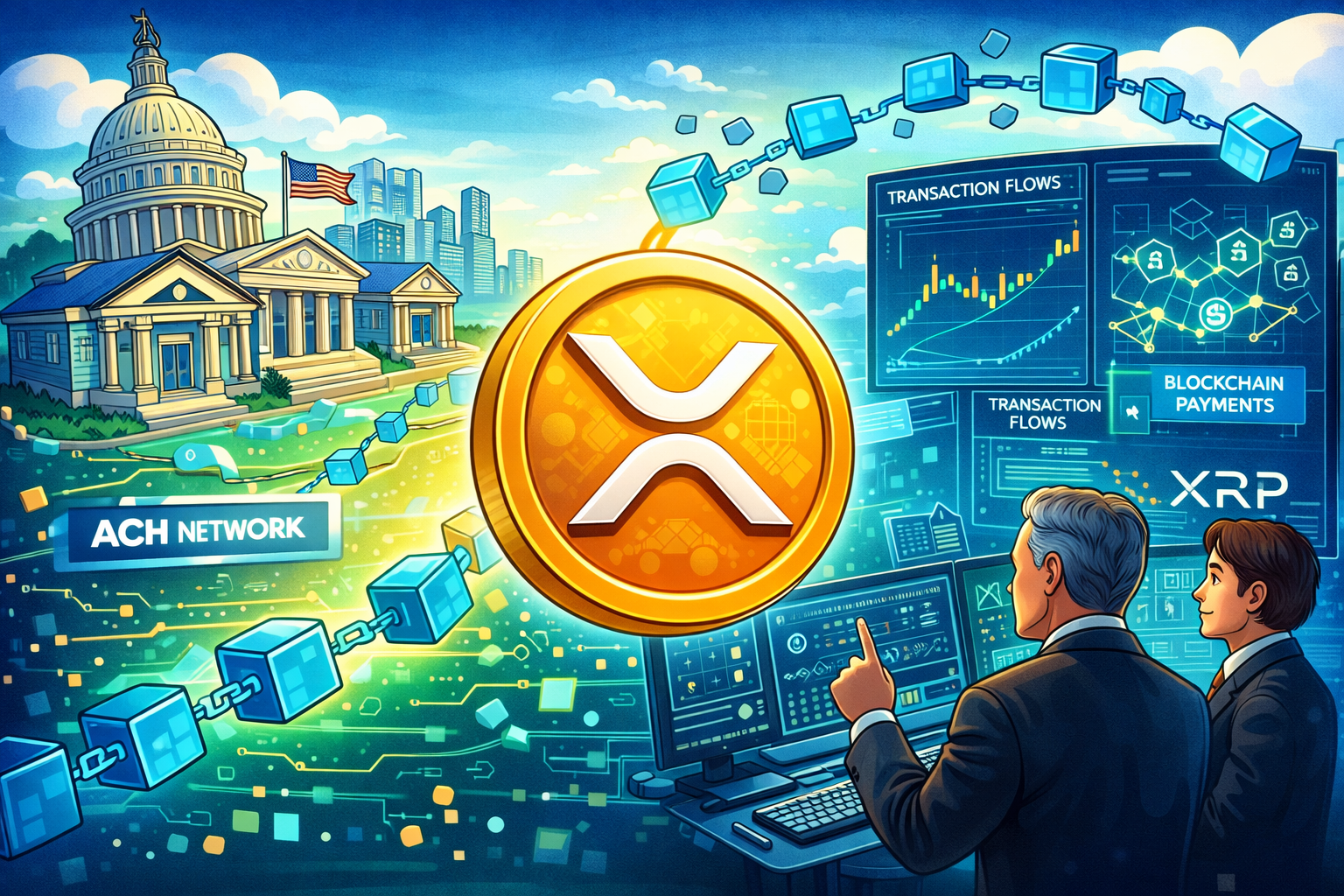
Ripple Enters the Conversation as U.S. Lawmakers Rethink the Future of Payments
U.S. lawmakers are beginning to explore a major overhaul of the country’s payment infrastructure, with discussions around modernizing the decades-old ACH network now intersecting with emerging blockchain technologies.
As policymakers evaluate how to upgrade systems that process trillions of dollars annually, new models for moving value are starting to enter the conversation — including blockchain-based payment networks.
Among the names surfacing in these discussions is Ripple, a company long associated with cross-border settlement technology. While no formal adoption has been proposed, the inclusion of blockchain players signals a broader shift in how regulators are thinking about the future of financial infrastructure.
A Legacy System Under Pressure
The Automated Clearing House (ACH) network has quietly powered the U.S. financial system for decades, facilitating payroll, bill payments, and bank transfers at massive scale.
Despite its importance, the system was designed for a different era — one where speed and always-on availability were not essential.
Today, ACH transactions are often:
- Processed in batches rather than instantly
- Delayed outside banking hours
- Dependent on intermediary institutions
- Limited in handling real-time financial demands
As digital commerce accelerates and global markets operate 24/7, these limitations are becoming more visible.
Why Blockchain Is Entering Policy Discussions
Blockchain technology offers a fundamentally different framework for payments.
Instead of relying on centralized clearing mechanisms, transactions can be validated across distributed networks, allowing for near real-time settlement and continuous operation.
This is why companies like Ripple are increasingly referenced in discussions around financial modernization.
Ripple’s infrastructure has been designed to:
- Enable faster settlement
- Reduce reliance on intermediaries
- Improve liquidity efficiency
- Support cross-border transactions
For policymakers, these capabilities are becoming harder to ignore — especially as global competitors begin adopting more advanced payment systems.
Regulation Is Driving the Shift
The exploration of payment system upgrades is closely tied to broader regulatory developments in the United States.
Lawmakers are actively working to establish clearer frameworks for digital assets, recognizing that the crypto sector is no longer operating at the margins of finance.
Efforts such as the proposed Crypto Clarity Act aim to define how digital assets are classified and regulated, providing a foundation for innovation within a structured environment.
As regulation evolves, it is opening the door for new technologies to be considered within existing financial systems — rather than outside them.
From Niche Innovation to National Infrastructure
Historically, blockchain-based payment solutions have been positioned as alternatives to traditional systems, particularly in cross-border use cases.
However, the possibility of applying these technologies to domestic infrastructure represents a significant shift.
Such a transition would require:
- Integration with existing banking networks
- Compliance with regulatory standards
- Proven scalability at national volumes
- High levels of security and resilience
While these challenges are substantial, the potential benefits — including faster settlement and reduced costs — are driving continued interest.
How Markets Are Interpreting the Development
For crypto markets, the inclusion of blockchain companies in policy discussions often triggers strong reactions.
Traders and investors may view these developments as:
- Early signals of institutional adoption
- Validation of blockchain use cases
- Indicators of a more favorable regulatory environment
However, it is important to distinguish between discussion and implementation.
Modernizing a system as large as the ACH network would likely involve years of planning, testing, and coordination across multiple stakeholders.
Why This Matters for the Future of Finance
If blockchain-based solutions were to play a role in modernizing U.S. payment infrastructure, the implications could be far-reaching.
Potential outcomes include:
- Faster and more efficient transactions
- Reduced costs for businesses and consumers
- Increased competition in payment services
- Greater innovation across financial products
At the same time, regulators would need to ensure that any changes maintain the stability and security of the financial system.
The Bigger Picture: Infrastructure Is the New Battleground
The discussion around the ACH network reflects a broader shift taking place across global finance.
Rather than focusing solely on digital assets as investments, attention is increasingly turning toward the systems that move money itself.
Blockchain technology is emerging as one of several contenders aiming to reshape this infrastructure — not by replacing existing systems overnight, but by gradually influencing how they evolve.
Ripple’s presence in these discussions highlights a key transition:
Crypto is no longer just about markets — it is becoming part of the conversation around how the financial system is built.
What Comes Next
The path forward remains uncertain, but the direction of travel is becoming clearer.
Lawmakers are beginning to acknowledge the need for modernization. Financial institutions are exploring new technologies. And blockchain companies are moving closer to the center of policy discussions.
Whether through gradual integration or broader reform, the future of payments in the United States is likely to look very different from the systems in place today.