


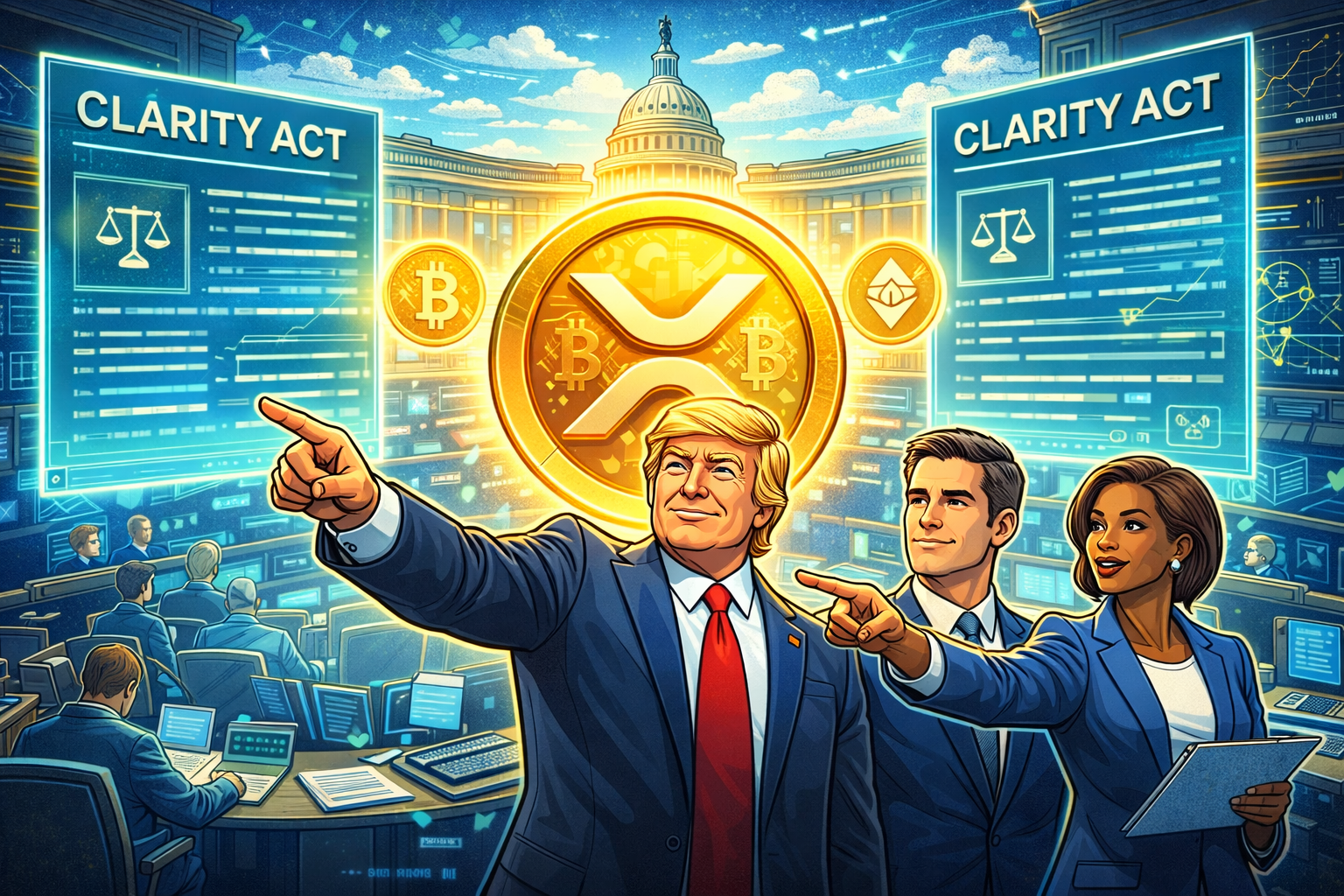
Crypto Regulation Moves to the Fast Track as Trump Pushes Clarity Act Forward
Momentum around crypto regulation in the United States may be accelerating.
Recent confirmation that the Digital Asset Market Clarity Act is moving to the front of the legislative agenda suggests that policymakers are no longer treating crypto as a secondary issue. Instead, it is becoming a central focus in shaping the future of financial markets.
This shift in priority could mark a turning point — not just for regulation, but for how digital assets are integrated into the broader financial system.
Why “Front of the Line” Matters
Legislation often moves slowly, especially when it involves complex financial frameworks.
So when a bill is pushed to the front of the line, it signals something important:
👉 Urgency
👉 Political alignment
👉 Recognition of economic impact
For crypto, this means the long-standing period of regulatory uncertainty may be approaching a resolution.
For years, companies, developers, and investors have operated in a fragmented environment — navigating unclear definitions and overlapping jurisdictions.
Now, that may finally change.
What the Clarity Act Is Trying to Solve
At the heart of the Digital Asset Market Clarity Act is a simple but critical goal:
Define what digital assets actually are.
The biggest issue in U.S. crypto regulation has been classification:
- Are cryptocurrencies securities?
- Are they commodities?
- Who regulates them — the SEC or the CFTC?
Without clear answers, enforcement has often replaced regulation.
The Clarity Act aims to establish a structured framework that distinguishes different types of digital assets based on their function and level of decentralization.
A Potential Shift in Power
One of the most closely watched aspects of the bill is how it could reshape regulatory authority.
If certain digital assets are classified as commodities rather than securities, oversight could shift more toward the Commodity Futures Trading Commission (CFTC), rather than the Securities and Exchange Commission (SEC).
This would represent a major change in how the industry is governed.
For many in the crypto space, this is seen as a more favorable outcome — one that aligns better with the decentralized nature of blockchain networks.
Why Markets Are Paying Attention
Regulatory clarity has always been one of the biggest missing pieces in crypto.
And when that clarity begins to take shape, markets tend to react.
Investors are watching closely because a defined framework could:
- Reduce legal uncertainty
- Encourage institutional participation
- Unlock new product development
- Increase confidence across the sector
In many ways, regulation is no longer viewed as a threat — but as a catalyst.
How This Connects to Broader Financial Trends
The push to fast-track the Clarity Act is happening at a time when traditional finance is already moving toward digital integration.
We are seeing:
- Tokenization of real-world assets
- Expansion of crypto ETFs
- Growth in stablecoin usage
- Increased interest from banks and asset managers
Without clear regulation, these trends remain limited.
With it, they could accelerate.
The Institutional Angle
For institutional players, regulation is not optional — it is essential.
Large financial firms require:
- Legal certainty
- Defined compliance frameworks
- Predictable regulatory environments
The Clarity Act could provide exactly that.
If passed, it may remove one of the biggest barriers preventing large-scale institutional capital from entering the crypto market.
Why This Moment Feels Different
Crypto regulation has been discussed for years.
But this moment feels different for one key reason:
👉 Priority.
When legislation moves from discussion to the front of the agenda, it signals intent.
And intent is what drives action.
Combined with growing political attention and economic relevance, the Clarity Act now appears to be part of a broader push to bring digital assets into the mainstream financial system.
The Bigger Picture: From Uncertainty to Structure
The crypto industry has spent much of its history operating in uncertainty.
That uncertainty has fueled innovation — but it has also created risk.
The Clarity Act represents a shift toward structure.
From:
➡️ Undefined rules
To:
➡️ A regulated framework for growth
And that transition is essential for the next phase of adoption.
What Comes Next
The legislative process is still ongoing, and outcomes are never guaranteed.
But the change in momentum is clear.
If the Clarity Act continues to move forward:
- Companies may begin preparing for compliance
- Institutions may increase engagement
- Developers may build with greater confidence
And the market may begin to price in a new era of regulatory clarity.
Final Thought
Crypto has long been waiting for a defining regulatory framework.
Now, that framework may be closer than ever.
And if momentum continues, the Clarity Act could become one of the most important pieces of legislation in the history of digital assets.