


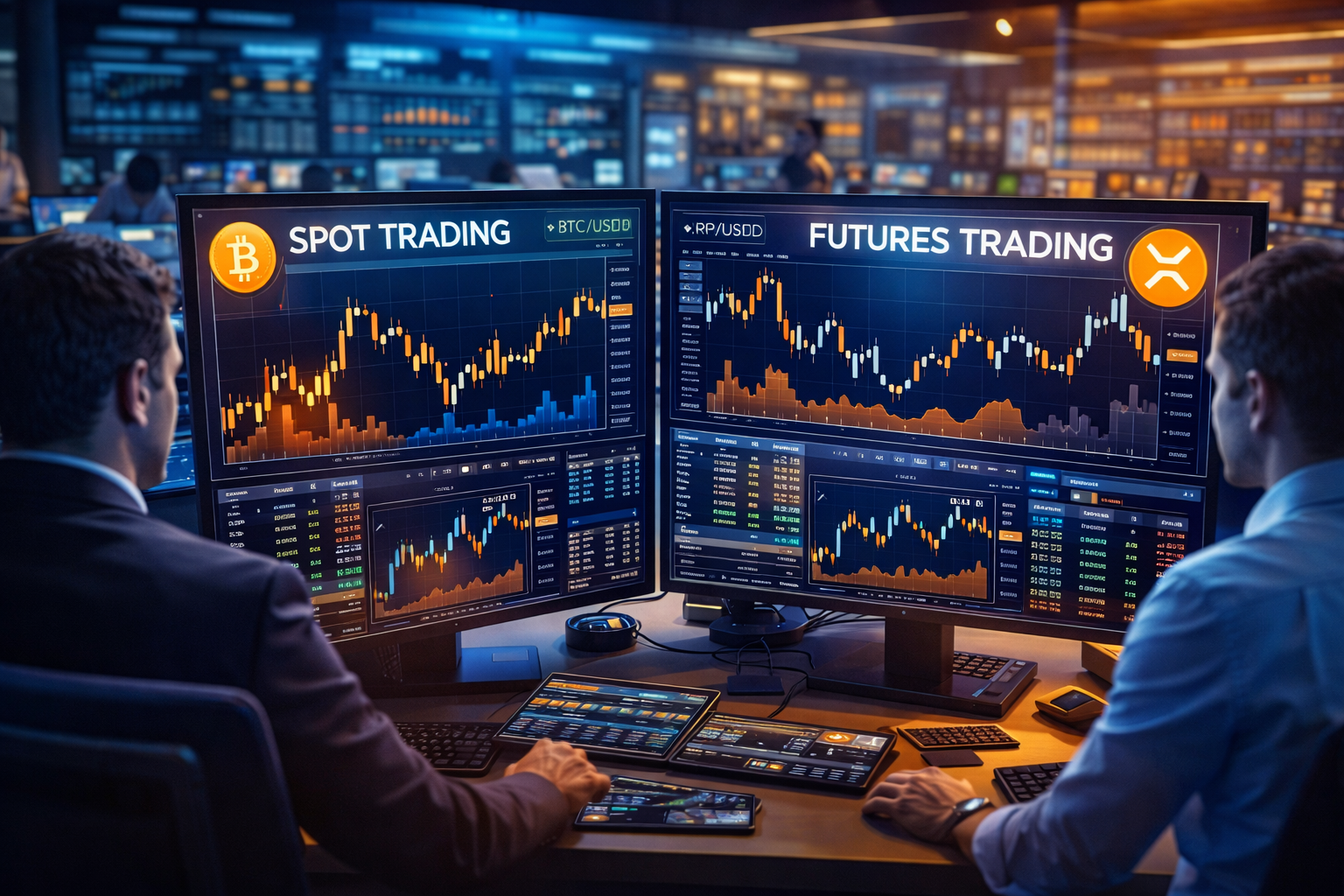
Cryptocurrency markets offer multiple ways to buy and trade digital assets, but two of the most common methods are spot trading and futures trading. While both involve speculation on price movements, the mechanics, risks, and strategies behind each approach are very different.
For newcomers entering the crypto market, understanding these differences can help prevent costly mistakes and improve long-term investment decisions. Many experienced traders recommend starting with spot markets before exploring derivatives such as futures.
In this guide, we break down how spot and futures trading work, their key differences, and which strategy may be more suitable depending on an investor’s risk tolerance.
Understanding the Spot Market
Spot trading is the most straightforward way to buy and sell cryptocurrencies. In a spot trade, an investor purchases a digital asset at the current market price, and ownership of the asset is transferred immediately.
For example, when someone buys Bitcoin on a spot exchange such as Coinbase or Kraken, the Bitcoin is credited directly to their exchange account or wallet.
Spot traders can then:
• transfer the asset to a personal wallet
• hold it long-term
• sell it later at a higher price
Because the investor actually owns the cryptocurrency, spot trading is often considered the foundation of crypto investing.
How Futures Trading Works
Futures trading is different because traders do not buy the underlying cryptocurrency itself. Instead, they trade contracts that track the price of a digital asset.
These contracts allow traders to speculate on whether the price will go up or down.
For example:
• A long position profits if the asset price rises
• A short position profits if the asset price falls
Many futures platforms also allow leverage, which means traders can control larger positions using a smaller amount of capital.
While leverage can increase potential profits, it also significantly increases the risk of losses.
Ownership and Custody Differences
One of the biggest distinctions between spot and futures trading is ownership.
In spot markets:
• the trader owns the actual cryptocurrency
• the asset can be transferred to personal wallets
• investors maintain direct control over the funds
In futures markets:
• traders do not own the underlying asset
• they only hold a contract tracking its price
Because of this, many investors prefer spot trading for long-term holdings, especially when they plan to store their assets in hardware wallets or cold storage.
Leverage and Risk Exposure
Leverage is one of the primary features that attracts traders to futures markets. Some exchanges allow leverage ratios as high as 10x, 20x, or even 100x.
This means a trader can open a position worth $10,000 with only $1000 in capital.
However, leverage magnifies both gains and losses. If the market moves against the position, the trader can face liquidation, where the exchange automatically closes the position to prevent further losses.
Because of these risks, leveraged futures trading is generally recommended only for experienced traders.
Market Volatility in Crypto
Cryptocurrency markets are known for their extreme volatility. Price swings of 5–10% within a single day are not uncommon.
This volatility creates opportunities for traders but also increases risk, particularly in leveraged environments.
Spot traders are less exposed to liquidation risk because they simply hold the underlying asset. Futures traders, on the other hand, must carefully manage leverage and margin levels.
For beginners entering the crypto market, understanding these dynamics is essential before choosing a trading strategy.
Why Many Investors Prefer Spot Trading
Spot trading remains the preferred strategy for many long-term investors.
Rather than actively trading short-term price fluctuations, many crypto investors follow a strategy known as buy and hold, accumulating assets over time and storing them securely in hardware wallets.
This approach avoids the complexity of derivatives markets while still allowing investors to benefit from long-term price appreciation.
Spot markets also provide greater flexibility because assets can be transferred between exchanges, wallets, and decentralized platforms.
Risk Management in Crypto Trading
Regardless of whether traders use spot or futures markets, risk management remains critical.
Successful traders often follow several key principles:
• never risk more than a small portion of capital per trade
• avoid excessive leverage
• diversify across different assets
• store long-term holdings securely
Security is particularly important in cryptocurrency markets because transactions cannot be reversed once confirmed on the blockchain.
How Traders Are Positioning Around Market Volatility
During periods of global economic uncertainty, cryptocurrency markets often experience increased volatility. Traders may rotate between spot and derivatives markets depending on the broader macroeconomic environment.
For example, during strong bullish trends, futures markets often see higher trading volumes as traders attempt to amplify profits through leverage.
However, when markets become unstable, many investors shift back toward spot holdings and focus on long-term strategies. This approach allows them to reduce exposure to liquidation risk while maintaining ownership of their assets.
These shifts between trading strategies are a normal part of how the cryptocurrency ecosystem responds to changing market conditions.
Why Crypto Markets React Faster Than Traditional Finance
Unlike traditional stock markets that operate within limited trading hours, cryptocurrency markets run 24 hours a day, seven days a week.
This continuous trading environment allows news, macroeconomic events, and regulatory developments to influence crypto prices almost instantly.
Because of this speed, traders often monitor multiple markets simultaneously, including spot exchanges and futures platforms. Price movements in derivatives markets can sometimes influence spot prices as traders adjust positions in real time.
Understanding how these interconnected markets operate gives investors a clearer view of overall market sentiment.