


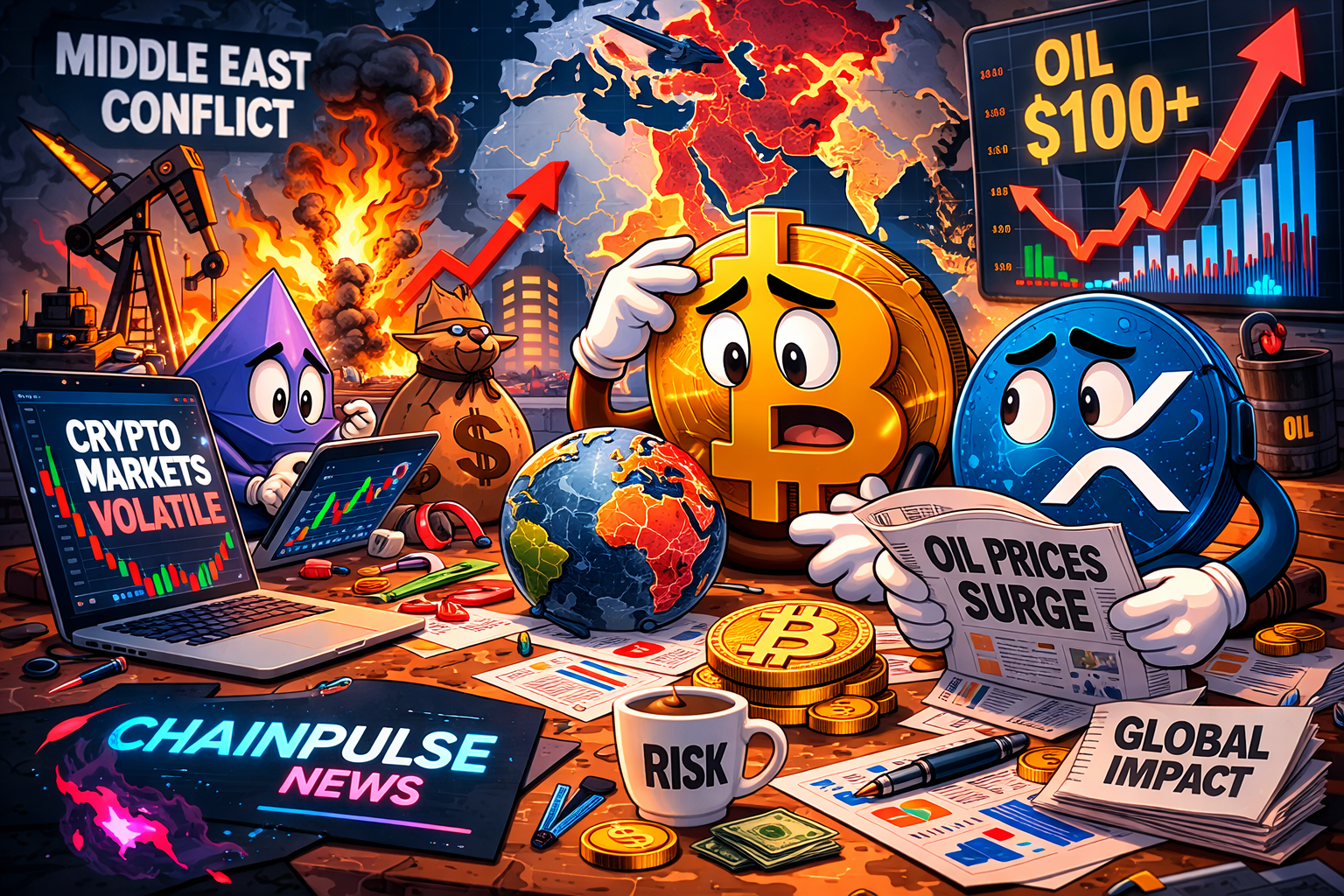
Global markets are reacting sharply to escalating tensions in the Middle East, with oil prices surging and risk assets turning volatile. While traditional markets closed lower on the news, cryptocurrency traders are watching the situation unfold in real time — highlighting crypto’s unique role as a 24-hour global risk barometer.
Energy Markets Trigger Global Volatility
Crude oil prices have surged above the $100 level as disruptions threaten supply routes in the Middle East. Analysts say the Strait of Hormuz — a key shipping corridor that carries roughly 20% of global oil supply — is now at the center of the disruption fears.
As tanker traffic slows and energy exports from the region face uncertainty, traders are rapidly repricing energy risk. In some cases, production in nearby countries has already been affected and shipping activity has declined due to security threats.
This surge in energy prices has historically spilled into financial markets, pushing investors toward safer assets and away from equities.
Crypto Markets React in Real Time
Unlike traditional markets, cryptocurrency markets operate continuously, allowing traders to respond instantly to geopolitical shocks.
Recent data suggests that Bitcoin and other digital assets often move as high-liquidity macro assets during periods of uncertainty. In previous geopolitical events, traders have used crypto as a rapid hedge against market closures or sudden risk shifts.
However, the reaction is not always bullish. Rising oil prices and fears of global inflation can also trigger short-term selloffs in risk assets, including cryptocurrencies.
Earlier during the conflict escalation, Bitcoin briefly slipped below key support levels as traders rotated capital across asset classes. Analysts noted that macro forces — not crypto-specific fundamentals — were driving most of the volatility.
Bitcoin’s Role During Global Crises
Geopolitical conflicts often create a mixed outlook for digital assets.
Bullish forces
- Capital flight from unstable regions
- Increased demand for censorship-resistant assets
- 24/7 liquidity during traditional market closures
Bearish forces
- Risk-off sentiment across financial markets
- Liquidity crunch in global markets
- Institutional portfolio rebalancing
Some analysts argue that longer conflicts tend to favor Bitcoin as the store-of-value narrative strengthens, while short-term shocks usually trigger volatility.
A Market Still Watching Energy Prices
For now, the crypto market is closely tracking movements in oil and global equities. If energy prices continue to climb, inflation expectations could rise again — forcing central banks to remain cautious on interest-rate cuts.
That macro backdrop would likely keep crypto markets volatile in the near term.
But as traders have learned repeatedly, geopolitical shocks rarely follow a straight line. And in a world where markets never sleep, digital assets remain one of the fastest ways investors express their view of global risk.
How Traders Are Positioning Around the Conflict
Market data suggests traders are taking a cautious stance as geopolitical risks remain elevated.
During periods of global uncertainty, trading volumes across cryptocurrency exchanges often increase as investors reposition portfolios and hedge exposure. Derivatives markets in particular tend to see heightened activity as traders adjust leverage and hedge risk.
Recent trading patterns indicate a mix of defensive positioning and opportunistic buying.
Some traders appear to be reducing exposure to volatile altcoins while maintaining positions in larger assets such as Bitcoin and Ethereum. Others are waiting for clearer macro signals before committing new capital.
This cautious approach reflects the uncertainty surrounding the duration and scale of the conflict.
If tensions escalate further, markets could experience another wave of volatility across both traditional and digital assets.
However, if the geopolitical situation stabilizes, risk appetite could return quickly — potentially triggering a rebound in crypto markets.
Why Crypto Markets React Faster Than Traditional Finance
One of the defining characteristics of cryptocurrency markets is their speed.
Unlike stock markets that operate within limited trading hours, digital assets trade continuously across global exchanges. This means major events — from economic announcements to geopolitical developments — are reflected in crypto prices almost instantly.
During global crises, this 24-hour trading structure often turns crypto markets into an early indicator of broader financial sentiment.
Traditional markets may only react when exchanges reopen, but crypto traders are already adjusting positions as news unfolds.
As a result, analysts increasingly watch Bitcoin and other major digital assets for clues about how investors perceive emerging risks.
While crypto is still evolving as an asset class, its constant liquidity and global accessibility mean it is becoming an increasingly important component of the world’s financial system.